
Key Takeaways
- - AI is already reshaping convenience retail across pricing, inventory, loss prevention, loyalty, labor, and foodservice - not as a future concept, but as a present-day advantage.
- - The value of AI depends entirely on data quality: fragmented POS, fuel, accounting, and inventory systems produce forecasts and insights you cannot trust.
- - A purpose-built C-Store ERP consolidates back-office accounting, pricebook, fuel, inventory, loyalty, and labor data into a single source of truth.
- - iRely’s convenience store ERP is built for multi-site retailers, giving operators the connected, real-time data that AI-driven decision-making requires.
Convenience Retail Is Getting Harder, and AI Is Changing the Math
Convenience store operators are running one of the most demanding retail formats in existence. Margins on fuel are thin and volatile; in-store margins depend on constant pricing discipline; labor is scarce and expensive and shrink quietly erodes profit across thousands of low-value transactions a day. Add foodservice, loyalty programs, lottery, and multi-site complexity, and the operational surface area becomes enormous.
Artificial intelligence is changing the math on all of it. AI can forecast demand SKU by SKU, flag a suspicious void the moment it happens, recommend a price change before a competitor takes the sale, and tell a manager exactly how much of a foodservice item to prep tomorrow. What used to require gut feel and end-of-month spreadsheets can now happen continuously and automatically.
But there is a catch that decisionmakers need to understand before they invest: AI is only as good as the data it runs on. And in most convenience operations, that data is scattered across a POS at each store, a fuel controller, an accounting package, and a stack of vendor portals. The real question is not “Should we adopt AI?” It is “Is our data ready for it?”

Where AI Is Already Changing Convenience Retail
AI adoption in convenience retail is uneven, some use cases are already table stakes, while others are just emerging. The table below maps the most relevant applications, what they deliver, and the data each one quietly depends on. Notice the pattern in the final column: every use case rests on clean, connected operational data.
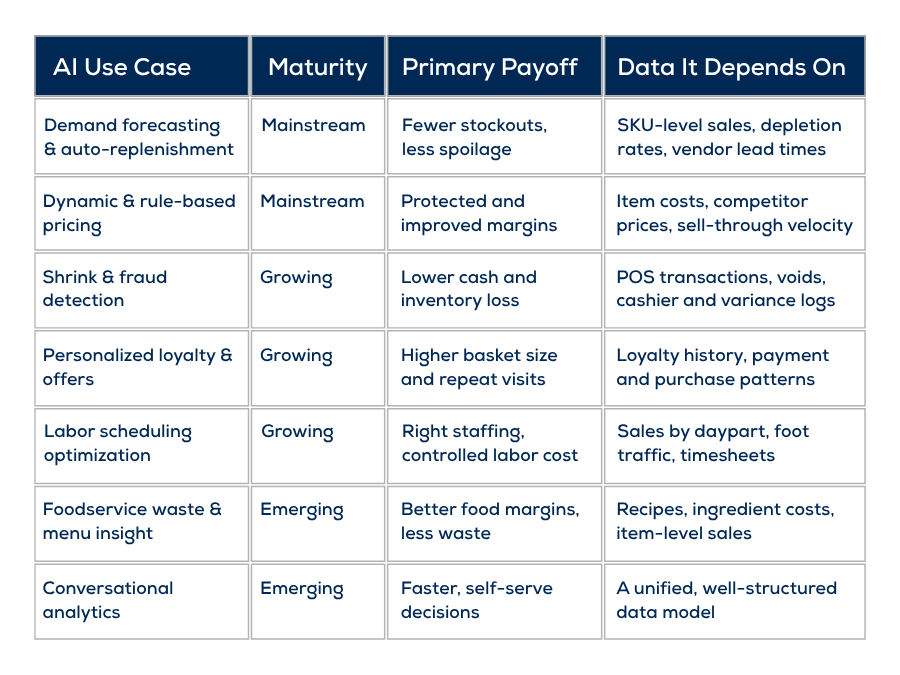
The common thread is unmistakable. Every high-value AI use case in convenience retail depends on structured, accurate, connected data. That is precisely the gap a modern C-Store ERP is designed to close.
Why Disconnected Systems Undermine AI
Most convenience operations did not design their technology stack, it accumulated. A POS at each location, a separate fuel management tool, an accounting platform that does not talk to either, and spreadsheets bridging the gaps. For a single store, this patchwork can limp along. Across a chain, it becomes the single biggest obstacle to using AI well.
The problem is that AI models amplify whatever they are fed. If item costs live in one system and sell-through velocity lives in another, a pricing model works from an incomplete picture. If cashier activity is not tied to inventory variances, a shrink-detection model cannot see the pattern that matters. Feed AI fragmented data, and it will confidently produce wrong answers, which is more dangerous than no answer at all.
There is also a speed cost. AI’s advantage is acting in near real time: adjusting a price, catching a fraud pattern, triggering a reorder. When data has to be manually exported, reconciled, and re-imported between systems, that real-time edge disappears. The operators who win with AI are the ones whose data already lives in one connected system.
Key Features of iRely’s Convenience Store ERP
iRely’s convenience store ERP is purpose-built for the C-Store industry, consolidating the back office into one connected platform, the unified foundation AI depends on. Here are the core capabilities that give operators visibility, control, and AI-ready data across every location.
- - Back-office accounting. Centralize sales, expenses, vendor invoices, and receivables across every location, with automated postings that keep inventory and financials updated in real time, simplified AP and AR, and easy import into leading accounting packages.
- - Pricebook and margin control. Protect profits with automated markups and markdowns, push mass price updates by group, store, or division in a few clicks, keep the POS in sync, and compare negotiated vendor costs against actual purchases - all while running enterprise-wide promotions.
- - Fuel management. Update pump prices remotely, schedule changes, and reconcile sales against tank levels in real time; record deliveries and settle balances with jobbers from the back office and generate the tank-inventory reports needed for EPA and state compliance.
- - Inventory, receiving, and purchasing. Scan items on arrival to match invoices and update inventory automatically, manage receipts and cycle counts, publish pricebook updates from handheld devices, and auto-generate purchase orders from forecasted sales and category depletion rates.
- - Loss prevention and compliance. Reconcile lottery and scratch-off sales and cash with built-in safeguards, lock critical fields and maintain audit logs to meet state requirements, and automate vendor rebate submissions to capture every eligible sale.
- - Labor, foodservice, and insights. Analyze staff performance and connect timesheets to payroll, control food costs and waste through recipe management, and monitor sales, margins, spoilage, and loyalty trends across all locations through interactive dashboards, real-time alerts, and secure cloud access.
How to Become an AI-Ready Convenience Retailer
- - Consolidate your systems first. Before chasing AI features, unify POS, fuel, accounting, and inventory data into one platform.
- - Clean and standardize your data. Standardize your pricebook, item categories, and vendor records, so models work from consistent inputs across every store.
- - Start where the ROI is clearest. Demand forecasting and margin control usually deliver the fastest, most measurable returns for convenience operators.
- - Connect the back office to the point of sale. Real-time sync between POS and back office is what lets AI act on current conditions rather than yesterday’s numbers.
- - Build governance and trust. Establish who owns data quality and how exceptions are handled so managers trust and act on the insights.
- - Choose a platform built for C-Stores. Generic retail tools need heavy customization for fuel, lottery, and foodservice; a purpose-built ERP brings those workflows out of the box.

The Single Source of Truth Advantage
When every transaction, fuel delivery, price change, and labor hour flows into one system, the data inconsistencies that break AI simply disappear. The margin your pricebook reports matches your financials, which matches what a forecasting model sees. Your leadership, store managers, and finance team all work from one version of reality, and any AI layered on top inherits that reliability.
iRely’s convenience store ERP is built around this philosophy. With nearly four decades of experience and more than 500 customers across over 25 countries, iRely designs software for industries where operational complexity meets tight margins. Its C-Store platform spans back-office accounting, pricebook and margin control, fuel management, inventory and purchasing, loyalty, labor, and foodservice - the full picture of a convenience operation in a single connected system.
That integrated architecture is what makes AI practical rather than aspirational. The records your team maintains for daily operations become the same clean, structured, real-time data that forecasting, pricing, and loss-prevention intelligence rely on. As AI reshapes convenience retail, the operators who move first with a trustworthy data foundation are the ones who turn it into durable margin advantage
Frequently Asked Questions
How is AI actually used in convenience stores today?
The most common applications are demand forecasting and auto-replenishment, dynamic or rule-based pricing to protect margins, shrink and fraud detection from POS data, personalized loyalty offers, and labor scheduling. Foodservice waste reduction and conversational analytics are emerging fast. Each depends on unified, accurate operational data.
Do I need AI features, or do I need better data first?
Data first. AI models amplify whatever data they receive, so fragmented systems produce unreliable results. Consolidating POS, fuel, accounting, and inventory into one platform is the prerequisite that makes any AI investment pay off.
Is iRely’s convenience store ERP suitable for multi-site operators?
Yes. The platform is designed for multi-store visibility and enterprise-wide control, letting operators manage pricing, inventory, fuel, and performance across every location from one system while scaling as the chain grows.
How does a unified ERP help with margins and shrink specifically?
Automated margin control applies markups and markdowns to protect profit, while real-time reconciliation across POS, inventory, and cash - plus built-in safeguards for lottery and audit logs - surfaces the variances and exceptions where shrink hides.
Build the data foundation AI depends on. Book a demo to see how iRely’s convenience store ERP unifies your back office into a single source of truth.